
TYCO SCANDAL - 2002
What happens when a CEO starts thinking company money is his own money, not shareholders’ money?

Hello guys, welcome to Weekly Wanted.
Today, I just wanted to share one of the most interesting corporate scandals in history. This is a short article compared to our regular deep dives, but the lesson behind it is extremely important.
Because sometimes, one scam can teach us more about management integrity than 100 finance books.
Now, let’s get into the scam.
Tyco Scandal (2002)
What happens when a CEO starts thinking company money is his own money, not shareholders’ money?
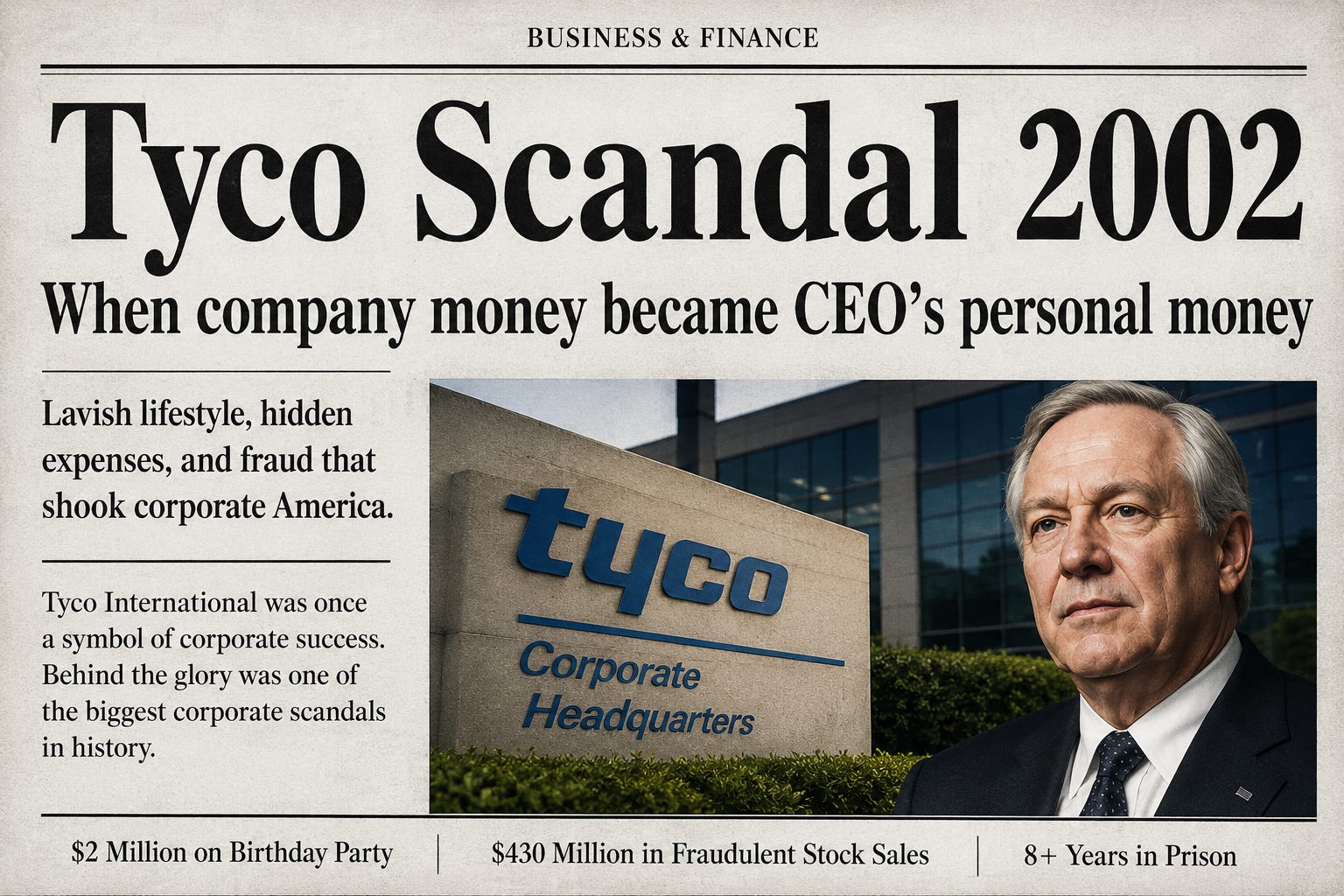
L. Dennis Kozlowski was one of the highest-paid CEOs in 1999. In just two years, from 1997 to 1999 alone, his compensation jumped from $8 million to nearly $170 million.
Dennis Kozlowski served as the CEO of Tyco International from 1992 to 2002.
This was the man who spent nearly $2 million on his wife’s birthday party — but filed it as a “director meeting expense” under the company name. He also spent around $14 million on artwork, treating Tyco like his personal piggy bank.
And it didn’t stop there.
He bought a $15,000 dog umbrella and a $6,000 curtain for his New York apartment using shareholder money. Company funds were treated like his own personal wallet.
Even worse, Dennis Kozlowski fraudulently sold nearly $430 million worth of company stock options, cheating his own shareholders.
Where did it all start?
To understand how all this happened, let’s go back to 1975.
A young 28-year-old named Dennis Kozlowski joined Tyco International. At that time, Tyco was mainly an investment and holding company. The CEO during that period was Joseph Gaziano.
Joseph Gaziano lived a lavish lifestyle — company jets, luxury cars, vacations, and country club memberships. Dennis Kozlowski was heavily influenced by Gaziano’s lifestyle, and over time Gaziano became both his mentor and close friend.
But in 1982, Gaziano died due to cancer.
After his death, Dennis Kozlowski worked extremely hard and genuinely created value for shareholders. His strategy was simple: aggressively cut costs and improve profitability in every nook and corner of the business.
After nearly a decade of hard work, Dennis Kozlowski finally became CEO in 1992.
But after becoming CEO, the real story started.
For years, he had worked for shareholders. But once he gained power, he slowly entered a completely different lifestyle — luxury parties, expensive homes in New York, and excessive spending. In many ways, he started following the same path as his mentor, Joseph Gaziano.
On one side, Dennis Kozlowski was enjoying a lavish lifestyle.
On the other side, for Tyco, he was actually delivering outstanding business performance.
He was extremely aggressive with acquisitions. Between 1997 and 2001, Tyco’s revenue grew nearly 48.7% annually. By February 2002, Tyco had spent more than $8 billion on over 700 acquisitions in just three years.
From the outside, it looked like extraordinary execution.
Because of this so-called outstanding performance, his compensation jumped from $8 million in 1997 to nearly $170 million in 1999.
But later, it came to light that Dennis Kozlowski and his CFO, Mark H. Swartz, had used manipulative accounting practices and inflated operating income by at least $500 million between 1996 and 2002.
But the real problem started when a lavish lifestyle slowly turned into greed.
Dennis Kozlowski, Mark Swartz, and some board members secretly took funds from Tyco without proper disclosure. They simply treated shareholder money as their own personal money and used it to fund luxury lifestyles.
Tyco International had basically become a giant personal piggy bank.
Dennis Kozlowski and Mark Swartz also fraudulently sold around $430 million worth of stock options. Another $230 million came through employee stock option manipulation, and around $106 million through unauthorized loan-forgiveness programs.
So on one side, he aggressively developed the company.
But on the other side, he slowly turned Tyco into his personal money-printing machine.
Later, he was arrested and sentenced to prison for more than 8 years.
The lesson we need to understand.
But the important lesson here is this:
In almost every scam, we come to know about the fraud only after the scam explodes. That’s why it is called a scam.
In financial frauds like Satyam Computer Services, people later discuss many quantitative checklists to identify whether financial statements are genuine or manipulated.
Things like:
Cash flow vs net profit
Auditor warnings
Debt vs profit growth
Receivables growth
Frequent equity dilution
Inventory build-up
Yes, these quantitative checklists help.
But if a smart CFO truly plans to manipulate the statements carefully, there is still a high probability that investors may not detect the warning signs early.
That’s why qualitative analysis becomes extremely important.
The only real checklist that can save investors is management integrity — and most of the time, integrity is qualitative, not quantitative.
And one of the best ways to judge management integrity is through conference calls.
Listen to at least 10–15 concalls.
Observe whether management is following the promises they made earlier. See whether their words and actions match over time.
It sounds like a simple task, but that’s exactly what makes it powerful.
Because if we don’t even know whether the balance sheet itself is genuine or manipulated, then doing quantitative analysis alone is not enough.
That’s why the qualitative side of analysis is equally as important as the quantitative side.
Because integrity is simple:
A person who consistently follows his promises is usually a person with integrity.
No checklist can guarantee that a company is fraud-free.
But tracking management integrity through concalls, actions, and capital allocation decisions at least increases the probability of avoiding disasters.
The simple question is this:
Is the promoter and management following their words and promises consistently over the years or not?
Sometimes, a simple yes-or-no question is enough.
Because numbers can be manipulated for some time.
But character eventually gets exposed.
If you want a complete guide on qualitative analysis and how to judge management integrity deeply, just comment:
“QUALITATIVE ANALYSIS”
We will upload it soon.
So what are your thoughts on financial statement manipulation, and what’s your checklist to identify it?
Until then, bye from Ragav JS.
See you in the next article.
If you genuinely like my work and want to go deeper into high-quality insights, detailed analysis, and real investing thinking, then join our premium community by clicking the Join button below.